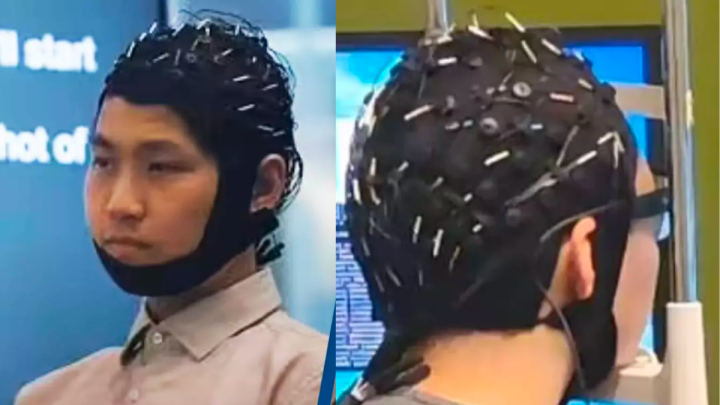
In a groundbreaking development, scientists at the University of Technology Sydney have introduced a mind-reading helmet capable of translating brain waves into readable text using artificial intelligence (AI). This technological leap signifies a remarkable advancement in the field of neuroscience, offering glimpses into the future of communication and human-machine interaction.
The innovative helmet, adorned with sensors, was tested with 29 participants who wore the device while reading out random texts. AI sensors meticulously tracked their brain waves, which were then translated into text resembling the original input. The electroencephalogram (EEG) recordings underwent conversion into text through the utilization of an AI model named DeWave.
The participants were prompted to think and articulate phrases, such as “Good afternoon! I hope you’re doing well. I’ll start with a cappuccino, please, with an extra shot of espresso.” Astonishingly, the AI successfully translated the brainwaves into a text response that closely mirrored the initial statement: “Afternoon! You well? Cappuccino, Xtra shot. Espresso.”
Despite the helmet’s impressive capabilities, the study revealed a 40% accuracy rate in its initial phase, based on the limited pool of participants. However, this breakthrough lays the foundation for future enhancements and refinements in mind-reading technology.
Chin-Teng Lin, affiliated with the University of Technology Sydney (UTS), emphasized the non-invasiveness, cost-effectiveness, and portability of the technology. Lin stated, “This research represents a pioneering effort in translating raw EEG waves directly into language, marking a significant breakthrough in the field. It is the first to incorporate discrete encoding techniques in the brain-to-text translation process, introducing an innovative approach to neural decoding.”
Unlike invasive alternatives such as Elon Musk’s Neuralink, which proposes the insertion of microchips into the brain, this helmet-style mind-reading technology offers a less ethically ambiguous and potentially dangerous solution. The translation process employs DeWave, which converts EEG signals into words using large language models (LLMs) derived from extensive EEG data.
Chin-Teng Lin envisions further research to achieve up to 90% accuracy in future readings, showcasing the commitment to refining and expanding the capabilities of this mind-reading technology. The breakthrough not only presents exciting possibilities for the future of communication but also underscores the ongoing fusion of neuroscience and AI, opening new frontiers in our understanding of the human mind. Watch this space for further developments in this extraordinary journey into the realm of mind-reading technology.