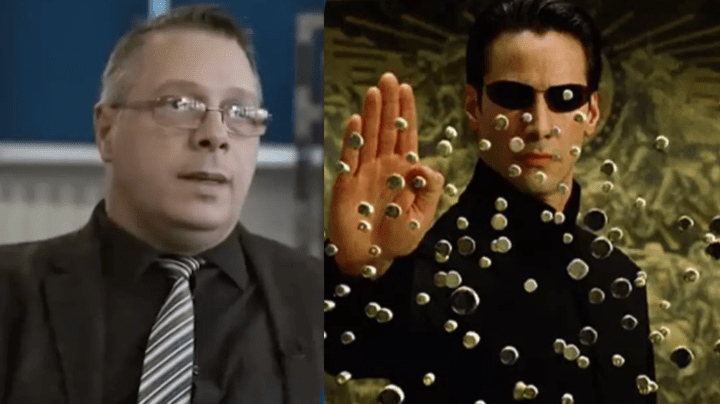
Do you ever get the nagging feeling that something is not quite as it seems, that there’s more to the reality we perceive? In the iconic words of Morpheus from “The Matrix,” “What you know you can’t explain, but you feel it. You’ve felt it your entire life.” Well, a physicist from the University of Portsmouth has taken the proverbial red pill and put forth claims suggesting we could be living in a “virtual reality simulation.”
Melvin Vopson, a physicist, argues that the universe’s underlying order resembles streams of information, while its patterns and symmetry reflect what one might encounter in a computer program. According to him, “My studies point to a bizarre and interesting possibility that we don’t live in an objective reality and that the entire universe might be just a super advanced virtual reality simulation. To put it simply, everything appears to evolve to an equilibrium state where the information content is minimal.” He likens this behavior to the principles employed in programming languages and computer coding, proposing that simulating a complex universe like ours would require a built-in data optimization and compression mechanism to reduce computational power and data storage needs for running the simulation.
While Professor Vopson acknowledges the skepticism surrounding this theory, he regards it as supportive of the “simulated universe theory,” though he stresses that it’s not “definite proof.” As part of his hypothesis, he suggests an alternative source for the elusive fifth state of matter.
Traditionally, this state is attributed to Bose-Einstein condensate, where extremely cold atoms coalesce and act as a single entity. However, Professor Vopson offers a novel perspective, proposing that information itself might have mass or influence over the universe. In his theory, he goes as far as to suggest that information could constitute the elusive “dark matter,” a mysterious substance accounting for nearly one-third of the entire universe’s mass, yet not fully understood.
Professor Vopson has previously raised concerns about an “information catastrophe,” a scenario in which the maximum possible digital information has been created, necessitating maximum power to sustain it.
In 2022, he even uncovered a new “law of physics” that could predict genetic mutations in organisms like viruses. This concept is based on the second law of thermodynamics, which dictates that the measure of disorder in an isolated system remains the same or increases. It’s certainly an intriguing theory.
So, if the world is indeed a simulation, does this mean we can quickly learn kung-fu or take to the skies at will? If not, then what’s the point, one might ask, but the mystery of our reality is one that continues to baffle and captivate our collective imagination.