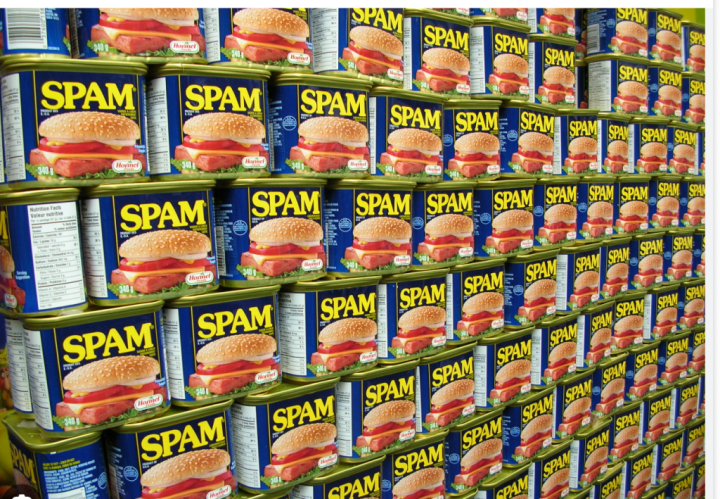
Revelation shakes culinary world as SPAM’s true meaning is unveiled…
No, it’s not related to unsolicited emails flooding your inbox.
It seems that it’s not just mind-boggling facts about ketchup preservation that are captivating online enthusiasts.
Internet food enthusiasts had their reality turned upside down when they finally discovered the true meaning behind the acronym SPAM, which has long been associated with the iconic canned pork product.
Initially introduced in 1937 by Hormel Foods, a food company based in Minnesota, this infamous meat slab has become synonymous with the enigmatic mystery meat found in culinary circles.
Thankfully, the ingredients of this culinary inside joke are not as mysterious as its reputation suggests. The ingredients are rather simple, especially in today’s world of additive-laden supermarket aisles: pork, water, salt, potato starch, sugar, and sodium nitrate.
However, the acronym has continued to baffle minds, with social media users, unfamiliar with food facts, coming up with their own theories about what the letters actually stand for.
“On a whim, I purchased canned meat,” shared one imaginative individual. “With the first taste, I realized that SPAM was an acronym for ‘Salt Preserves Any Meat.’” Another theory suggested, “What does SPAM stand for? Salty Piece A’ Meat?”
“I always speculated that ‘Spam’ was an acronym for ‘Spoiled Ham,’” joked one armchair gourmet, while a witty Twitter user quipped, “I just learned that SPAM is an acronym for Sizzle Pork And Mmm.”
Others referred to the old Bill Engvall joke that SPAM stands for “stuff posing as meat.”
There were other misconceptions circulating as well, such as “scientifically processed animal matter” and “shoulder of pork and ham.”
Some bewildered commenters were not even aware that SPAM was an acronym. “I was today years old when I learned that SPAM is an acronym,” confessed one astonished individual.
As it turns out, SPAM is actually a combination of the words “spiced ham,” conceived by actor Ken Daigneau, the brother of a Hormel executive, during a naming contest, as reported by Time.
According to Eater, Daigneau casually blurted out “Spam” as if it were nothing at all, which struck a chord with company founder Jay Hormel. In 1945, Hormel revealed to New Yorker writer Brendan Gill, “I knew then and there that the name was perfect.”
SPAM made its debut on store shelves on July 5, 1937, providing a much-needed affordable food option during the Great Depression, according to the Hormel Foods website. Its popularity soared during World War II due to its remarkable shelf life, allowing the pork product to be transported anywhere in the world.
Today, SPAM is available in 44 different countries.
Originally introduced as an economical canned food, this humble meat block has undergone a transformation, now considered a trendy delicacy. This culinary reinvention reached New York City with the introduction of Hawaiian and Japanese-inspired dishes, like SPAM fried rice with seared ahi tuna, at Sushi Ko in 2014.