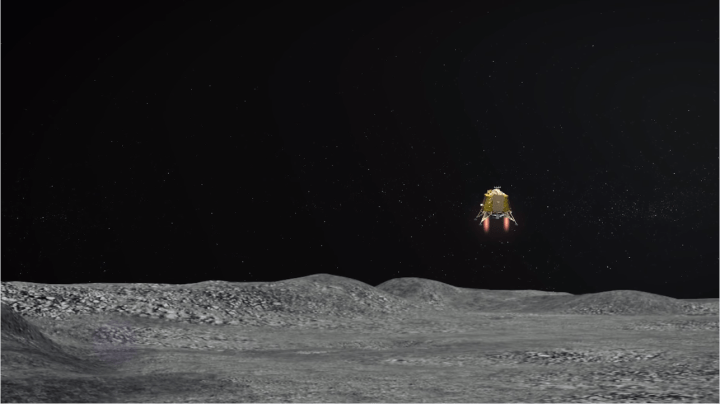
India’s Vikram lunar lander has recently detected intriguing movement beneath the lunar surface, marking a significant scientific discovery. While this development has sparked curiosity and raised questions about lunar anomalies, experts believe it’s unlikely to be evidence of extraterrestrial life. Instead, they attribute the observed phenomenon to lunar seismic activity, akin to earthquakes. This remarkable revelation represents the first time that such “moonquakes” have been recorded since the 1970s.
The detection of this lunar movement was made possible by the Vikram lander’s specialized equipment designed for monitoring lunar seismic activity. This instrument is specifically designed “to measure ground vibrations generated by natural quakes, impacts, and artificial events,” as detailed by the Indian Space Research Organization (ISRO).
India’s Chandrayaan-3 mission achieved this groundbreaking discovery when it successfully landed both the Vikram lander and its companion spacecraft, the Pragyan rover, last month. This accomplishment placed India in an exclusive group of nations, making it the fourth country to achieve a lunar landing, following the United States, the former USSR, and China. Moreover, India’s mission targeted the Moon’s less-explored South Pole, contributing valuable data to our understanding of this celestial body.
The significance of this recent seismic activity on the Moon lies in its historical context. The last recorded instances of lunar seismic activity occurred during the US Apollo program, which concluded in 1977. These earlier recordings provided scientists with invaluable insights into the Moon’s composition and structure. Among the key findings, researchers theorized that the Moon possesses an inner core with significantly lower density compared to Earth’s inner core, spanning approximately 500 kilometers in diameter.
Intriguingly, the mechanisms behind lunar seismic activity differ from those on Earth, where such phenomena result from the movement of tectonic plates. On the Moon, distinct factors come into play. Lunar quakes may originate from thermal activity induced by the Sun’s influence or from tidal stresses caused by Earth’s gravitational forces. These forces may cause the Moon’s surface to crack, leading to the observed seismic events, as pieces of the lunar crust rub against each other.
To emphasize the ongoing scientific exploration and analysis, experts involved in the Chandrayaan-3 mission have highlighted that this lunar seismic event is currently under thorough investigation. While it’s not definitive proof of extraterrestrial activity, it serves as a testament to humanity’s relentless pursuit of knowledge and understanding of the celestial bodies in our cosmic neighborhood.