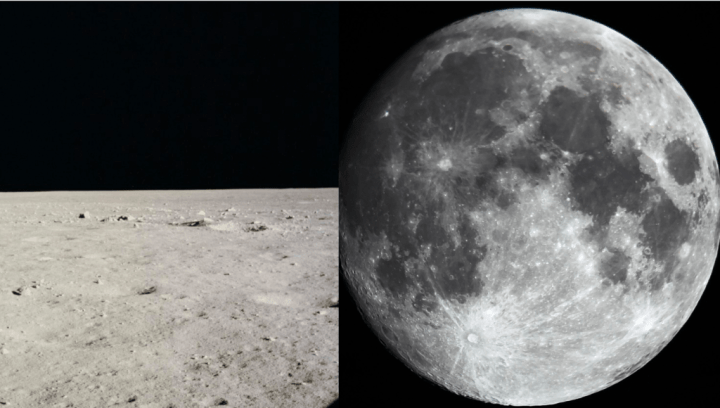
India’s remarkable achievement in lunar exploration reached a historic milestone as the first-ever photograph from the moon’s enigmatic south pole was unveiled. The momentous event follows the successful landing of India’s Chandrayaan-3 spacecraft, marking an unparalleled step in space exploration.
The Indian Space Research Organisation (ISRO) promptly shared the awe-inspiring image, captured by the moon lander’s imaging camera merely three hours after touchdown. The photograph reveals a relatively even expanse on the lunar surface, with the lander’s leg and its accompanying shadow elegantly gracing the right-hand corner of the frame. Earlier in the mission, ISRO had released a series of images snapped by the moon lander’s horizontal velocity camera, depicting the rugged terrain during its dramatic descent.
The moon’s surface, when viewed from above, possesses a textured ruggedness that evokes the appearance of yeast bubbles suspended in bread dough, with its intricate dimples and grooves painting a unique celestial canvas.
Within the lunar craft lies a compact rover, weighing a mere 26 kilograms, which is equivalent to three full-sized watermelons. This pint-sized rover has embarked on its exploration of the lunar region shortly after the lander’s triumphant touchdown.
Following more than two weeks in lunar orbit, the lander gently settled onto the lunar south at 18:02 Indian Standard Time (13:32 BST) on a momentous Wednesday. The rover, wasting no time, commenced its traverse of the region mere hours after disembarkation, a journey that the ISRO has confirmed. Equipped with an array of scientific instruments, both the lander and rover are poised to study the lunar terrain for approximately one lunar day, equivalent to 14 Earth days.
The reliance on solar power means that as the sun dips below the lunar horizon, signaling the onset of the lunar night, both lander and rover will be enveloped in darkness, rendering them non-operational.
ISRO pledged that further updates on the mission’s progress are forthcoming as the craft navigates uncharted territory, pushing the boundaries of human exploration.
Notably, India’s achievement stands as a pioneering moment, as it becomes the first nation in history to successfully land a spacecraft on the moon’s enigmatic south pole. While the United States, Russia, and China have previously managed lunar landings, India’s feat is unique in its geographic choice.
The significance of the moon’s southern region, with its intriguing ruggedness, has captured the attention of space agencies globally, including Russia, China, and the US. Its potential as a water reservoir in the form of frozen ice, known as ‘cold traps,’ is particularly enticing. These cold traps could harbor water ice for thousands of years, offering insights into a myriad of scientific phenomena, from microbial life records to lunar volcanic activity.
The wealth of water ice in the south pole area has positioned it as a potential site for future human habitation, aligning with NASA’s ambitious Artemis program.
Chandrayaan-3’s journey commenced over a month ago, lifting off from the Satish Dhawan Space Centre north of Chennai on July 14. Unlike the swift lunar trajectories of the Apollo missions, Chandrayaan-3 took a more leisurely approach due to India’s reliance on less powerful rockets. These rockets necessitated multiple Earth orbits to gather speed before embarking on the month-long lunar journey.
India’s aerospace program, while budget-conscious, has steadily grown in size and capability since its first lunar orbiter mission in 2008. The latest Chandrayaan-3 mission bears a modest price tag of $74.6 million, a testament to India’s adeptness at resourceful space engineering.
This ability to minimize costs stems from a strategy of adapting existing space technology and tapping into a pool of highly skilled engineers who earn considerably less than their international counterparts.
India’s accomplishments extend beyond lunar exploration, having become the first Asian nation to launch a satellite into Mars’ orbit in 2014. The country’s ambitions continue to flourish, with plans to launch a three-day manned mission into Earth’s orbit in the near future.
Collaborations are also underway, including a partnership with the Japanese Space Agency (JAXA) for Chandrayaan-4, slated for a tentative launch in 2025 or 2026. This mission aims to follow in the footsteps of Chandrayaan-3 but with an extended operational lifespan.