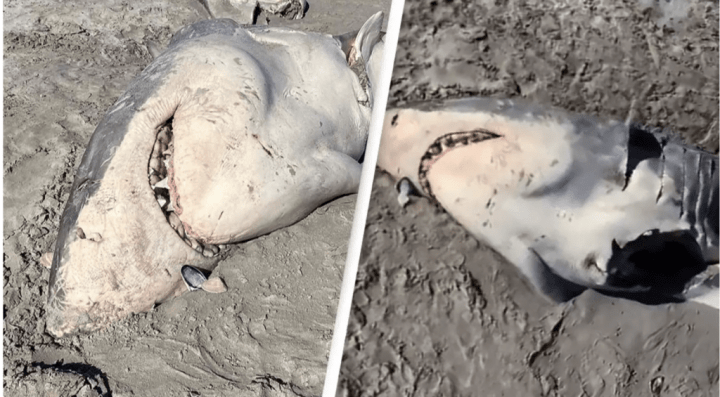
Great white sharks are often depicted as the most fearsome predators in the ocean, but even these apex predators can find themselves in peril. In a stunning display of nature’s raw power, a half-eaten great white shark washed up on a beach in Victoria, Australia, sending shockwaves among beachgoers.
Images from the beach reveal the grim scene, with only remnants of the unfortunate shark remaining. Once approximately four meters in length, the shark’s decimated body was a haunting sight. The question on everyone’s mind was: What could have inflicted such devastation on a creature as formidable as a great white shark?
The answer, it turns out, lies in the ocean’s hierarchy, where even apex predators have predators of their own. While great white sharks are certainly formidable, there exists one marine creature that reigns supreme with no natural adversaries, and it preys on creatures from the tiniest herring to the colossal blue whale.
Yes, it’s the monochrome menace of the seas—the orca, also known as the killer whale. Orcas are larger, more intelligent, and have a particular penchant for shark liver.
It was the aftermath of one such orca attack that led fisherman Ben Johnstone to the grisly discovery of the shark’s mutilated body on Bridgewater Beach near Cape Bridgewater on October 17. Johnstone, 28, shared his insights, explaining, “I’m pretty certain it was killer whales – they kill sharks just for the livers; it’s the only part of them that they eat.”
The reason so little remains of a shark’s carcass after an orca attack is due to their precision. Once the orcas are finished with their meal, the remaining intestines, stomach, and other organs would naturally fall out, as there is nothing left to hold them inside.
Reports from local media indicated that a pod of orcas, which are actually the largest species of dolphins rather than true whales, had been spotted in the area a couple of days prior to the discovery.
Tropical ecologist Lauren Meyer explained that orcas are known for their selective eating habits. She stated, “We see this with things like humpback whales, where killer whales come in and actually eat the tongue and leave the rest of the whale. We certainly see that they prefer the liver of white sharks, mako sharks, bronze whalers, sevengills, and even tiger sharks.”
Ben Johnstone, who made the discovery, expressed his fascination with the incident, saying, “I was intrigued more than anything. I found it pretty cool that something like that happened in our local waters.”
One theory is that orcas have a unique hunting method for sharks. They are known to flip sharks onto their backs, rendering them catatonic and immobile, making them easy prey for the orca’s powerful jaws. In fact, there have been accounts of great white sharks fleeing an area en masse when orcas are in the vicinity, with some tagged sharks even diving to depths of 500 meters to evade their pursuers. This remarkable natural phenomenon illustrates the intricate dynamics of ocean life and the awe-inspiring power of these marine creatures.