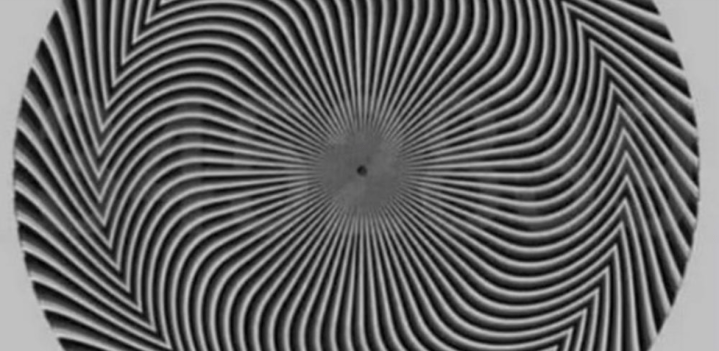
Optical illusions, while entertaining, also offer valuable insights into the workings of our brains. These illusions are classified as physiological illusions, designed to captivate our minds by intensifying light and utilizing shapes and colors. They induce the illusion of movement in a static, two-dimensional image. The particular illusion in question comprises a circular black pattern set against a grey background, adorned with swirls and sharp angles. Concealed within this intricate design is a hidden number, rendered in a subtle shade of grey, which is the central challenge for viewers.
The responses to this optical puzzle have been remarkably diverse. People have reported seeing numbers of varying lengths within the pattern, with no definitive consensus regarding the correct answer. Some individuals identified a brief number, while others discerned a longer sequence. An individual with limited central vision in one eye, for instance, only perceived the digit ‘2.’ In contrast, someone else identified ‘528’ and pondered whether this might be indicative of their eyesight.
However, some individuals managed to perceive a more extensive set of numbers concealed within the illusion, ranging from five to seven digits. Nevertheless, not all interpretations aligned with the actual answer. These disparities may be attributed to the concept of “contrast sensitivity.”
When images induce a perception of motion and depth, they can confound the brain, leading to assumptions and filling in gaps. This is due in part to the delay of about 100 milliseconds between what our eyes perceive and how our brains process information. The brain constantly anticipates forthcoming motion and events to ensure coordination and safety. The current illusion, in particular, hinges on contrast sensitivity, which plays a pivotal role in distinguishing foreground objects from backgrounds.
Contrast sensitivity holds significance, especially in contexts like driving, where adverse conditions such as fog, high glare, or low-light can hinder visual acuity. In this optical conundrum, the numbers and the pattern occupy distinct planes, and the varying shades create challenges in differentiation. The accuracy of one’s interpretation becomes a telling indicator of their visual acuity.
The full answer to this puzzle is ‘3452839.’ If you’re still struggling to discern it, here’s a helpful tip: lay your phone flat on a surface rather than holding it upright in front of you. Alternatively, adjust the angle of your computer screen to flatten the image, and the complete sequence of digits should become evident.