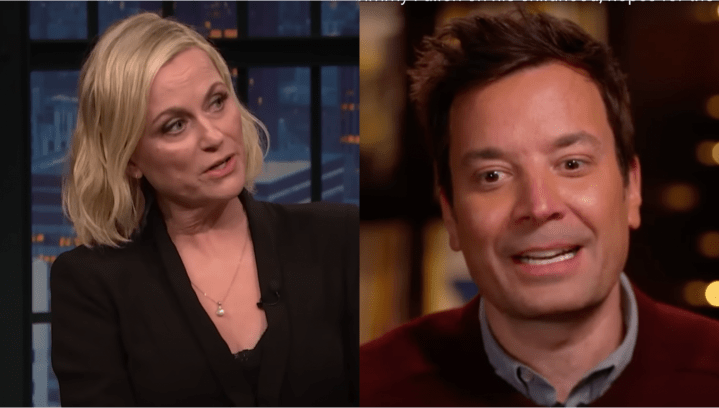
A long-forgotten exchange between former “Saturday Night Live” colleagues, Jimmy Fallon and Amy Poehler, has resurfaced amid allegations of a toxic work environment on Fallon’s late-night show. The viral interaction, initially recounted in Tina Fey’s 2013 autobiography “Bossypants,” sheds light on a moment when tensions ran high during a table read for the NBC variety show.
The incident unfolded when Poehler, relatively new to the “SNL” cast at the time, engaged in a playful, albeit vulgar, exchange with Seth Meyers across the table. Fallon, in response, voiced his disapproval, exclaiming, “Stop that! It’s not cute! I don’t like it.” According to Fey’s account, Amy Poehler’s reaction was swift and uncompromising. She abandoned her jesting with Meyers and confronted Fallon, declaring, “I don’t f–king care if you like it.”
Fey’s recollection paints a vivid picture of Amy Poehler’s determination and refusal to conform to societal expectations. She made it unequivocally clear that she was not there to play stereotypical roles, such as wives and girlfriends in sketches designed by the male-dominated ensemble. Poehler was there to express herself authentically, and she wasn’t concerned about whether it was deemed “cute” or not. This resolute stance left Fallon taken aback as Poehler returned to her humorous banter with Meyers.
The recent resurgence of this incident coincides with a Rolling Stone article that alleges a tumultuous work environment on Jimmy Fallon’s show, where staffers reportedly experienced distress and even suicidal thoughts due to his erratic behavior. Some recounted instances of Jimmy Fallon’s unpredictable mood swings, describing how they were forced to tread cautiously, especially showrunners who bore the brunt of his volatility.
One former employee recalled an incident from 2017 when Fallon appeared disoriented, crossing out jokes on a piece of paper and then forgetting that he had done so, leading some to speculate whether he was under the influence of alcohol. The workplace environment became increasingly stressful, and one staffer admitted to reaching a point of such despair that they contemplated ending their own life.
Fallon’s issues with alcohol and partying were previously reported in 2015 when a bartender who served him described him as “a mess.” The overarching theme appeared to be a lack of intervention or willingness to confront Fallon’s behavior, with insiders suggesting that nobody dared to tell him “No.”
The Rolling Stone exposé also included accounts of Fallon belittling crew members and employees over minor mistakes, creating an atmosphere of fear and tension. When Fallon was in a bad mood, it was said that the entire office environment became strained, and employees refrained from casual interactions or banter for fear of setting off his volatile temperament.
In response to the allegations, Jimmy Fallon issued an apology to his staff during a Zoom meeting. He expressed his embarrassment and remorse, acknowledging the discomfort he had caused them and their families and friends.
“It’s embarrassing and I feel so bad,” Fallon reportedly said. “Sorry if I embarrassed you and your family and friends… I feel so bad I can’t even tell you.”
Despite the allegations, some of Fallon’s friends, including comedian Jerry Seinfeld, have come to his defense. Seinfeld dismissed the controversy, stating, “This is so stupid. I remember this moment quite well,” referring to the exchange with Amy Poehler. He emphasized that it was a light-hearted teasing moment, devoid of discomfort, and that he and Fallon continue to share a laugh over it, labeling the entire situation an “idiotic twisting of events.”
The resurgence of the Fallon-Poehler exchange in the context of the recent allegations has reignited discussions about workplace dynamics in the entertainment industry, prompting reflection on the complexities and challenges faced by those working in high-pressure environments.