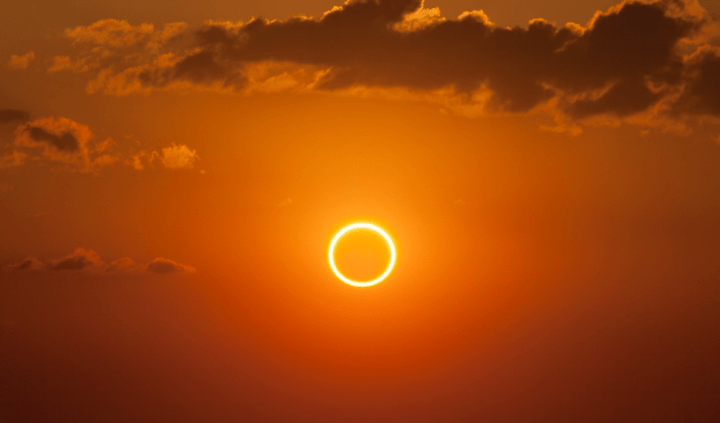
This week, sky enthusiasts will have the extraordinary opportunity to witness a solar eclipse known as the “ring of fire,” an event that won’t grace our skies again until 2046. The anticipation surrounding this celestial spectacle is palpable, as technological advancements promise transformative experiences in the years to come. However, for now, the age-old tradition of gazing skyward with the appropriate eye protection remains the method of choice.
Scheduled for October 14th, this solar eclipse earns its moniker, the “ring of fire,” due to the sun’s radiant light encircling the moon’s shadow. The celestial show will be on display over North, Central, and South America, with NASA offering a live stream from Albuquerque, New Mexico; Kirbyville, Texas; and White Sands, New Mexico.
While NASA is set to provide a live stream, local residents are encouraged to witness this rare spectacle in person, as it won’t grace our skies again anytime soon. Kelly Korreck, NASA’s eclipse program manager, emphasized the rarity of the event, saying, “The next annular eclipse seen in this part of the country is actually going to be in 2046. It’s going to be a long stretch before we will see this phenomenon again, so we’re really encouraging folks to go out there and observe safely.”
To protect your eyes during this event, it is crucial to wear specialized eclipse glasses or use a handheld solar viewer. Observers can also experience the eclipse through telescopes, binoculars, or cameras equipped with solar filters on the front. Ordinary sunglasses do not provide adequate protection and can cause severe eye damage.
The solar eclipse is set to commence at 12:13 pm ET, beginning from the Oregon coast and journeying to Texas’ Gulf Coast. Observers in Oregon, Nevada, Utah, New Mexico, and Texas will have the privilege of witnessing this celestial dance. For residents in select regions of California, Idaho, Colorado, and Arizona, the event will be visible before concluding at 1:03 pm ET.
In areas directly in the path of the eclipse, observers will experience up to five minutes of the sun being obscured, resulting in a noticeable darkening of the sky and a drop in temperature.
For those eager to track the eclipse, NASA has developed an interactive eclipse tracker, providing information about prime viewing locations. However, residents in other parts of the continental United States may still have the opportunity to witness a partial solar eclipse, where only a portion of the sun is concealed by the moon, weather permitting.
As we await the next eclipse in 2046, this week’s “ring of fire” solar eclipse serves as a captivating reminder of the timeless allure and wonder of celestial events.