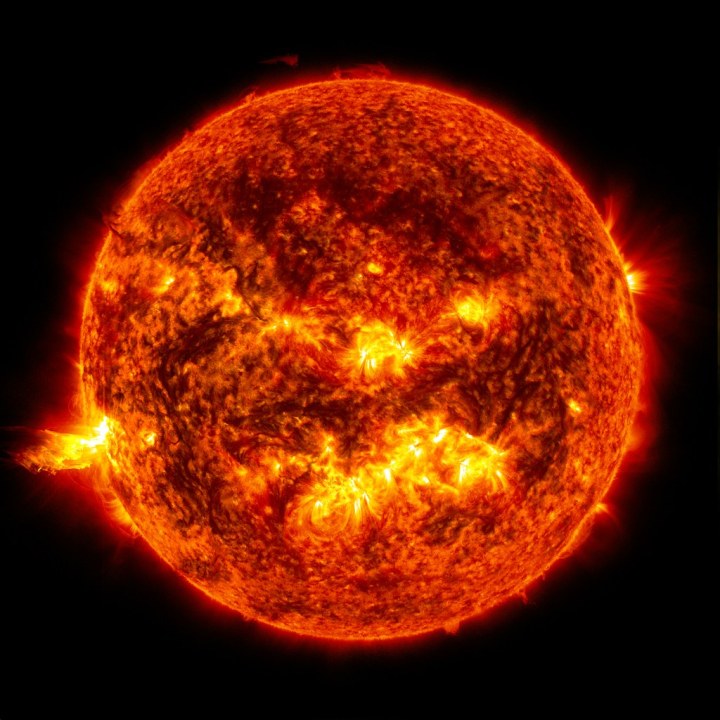
In a recent revelation, a colossal hole has manifested in the Sun, a development that has left both experts and enthusiasts intrigued and, perhaps, a tad uneasy. While the notion of a breach in the Sun might sound disconcerting, it’s important to understand the scientific intricacies behind this celestial event.
Amidst the awe and fear of technological advancements, one cannot deny the valuable insights they provide into our planet and the expansive solar system. Recent observations have brought to light the existence of an immense hole in the Sun, unleashing potent streams of abnormally swift radiation recognized as solar wind.
Despite the vast distance separating us from the Sun, the implications of this phenomenon extend directly to Earth. The Sun, with its immense gravitational influence, propels this formidable radiation towards our planet, prompting a closer examination of its potential impact.
It’s crucial to note that this breach in the Sun is not a perpetual state; rather, it is a temporary occurrence, albeit with unprecedented characteristics in terms of both size and orientation. Scientists describe this colossal void as a coronal hole, emphasizing its magnitude, which surpasses that of 60 Earths. Notably, such an extensive and centrally located gap is deemed rare at this juncture in the solar cycle.
The birth of this solar anomaly dates back to December 2 when it materialized near the Sun’s equator. Remarkably, within a mere 24 hours, it expanded to a width exceeding 800,000 kilometers, positioning itself directly at Earth’s trajectory since December 4.
Understanding the mechanism behind this phenomenon reveals that it occurs when the Sun’s magnetic fields, responsible for maintaining its structural integrity, suddenly give way. The National Oceanic and Atmospheric Administration (NOAA) elucidates that this event prompts the sun’s upper surface contents to disperse as solar wind. Unfortunately, the naked eye cannot perceive coronal holes, requiring ultraviolet light observation to detect them.
Initial apprehensions were raised about potential repercussions, as experts speculated that the solar wind emanating from the recent hole might induce a geomagnetic storm. Such a storm could potentially lead to radio blackouts and vibrant auroral displays in the following days. However, subsequent evaluations indicate that the solar wind’s intensity is milder than anticipated, resulting in only a faint storm thus far.
Spaceweather.com suggests that despite the subdued solar activity, auroras could still grace the skies, leaving enthusiasts in anticipation. As time unfolds, the celestial drama will continue to unravel, offering a fascinating spectacle of the interplay between our Sun and Earth.
In a different cosmic narrative, last month witnessed a celestial spectacle as four continents were treated to a total solar eclipse. Encompassing North and Central America, Asia, Australia, the Pacific Islands, and segments of South America, the eclipse on November 8 captivated observers worldwide. This event, where the Earth, moon, and sun align, creating a lunar eclipse, was touted as the final occurrence until 2025 – an astronomical milestone worth marking on calendars. As the cosmos continues to unveil its mysteries, each celestial event serves as a reminder of the dynamic interactions within our solar system.